Happ Coffee Roasters
Costa Rica Don Senel Red Honey
Costa Rica Don Senel Red Honey
Couldn't load pickup availability
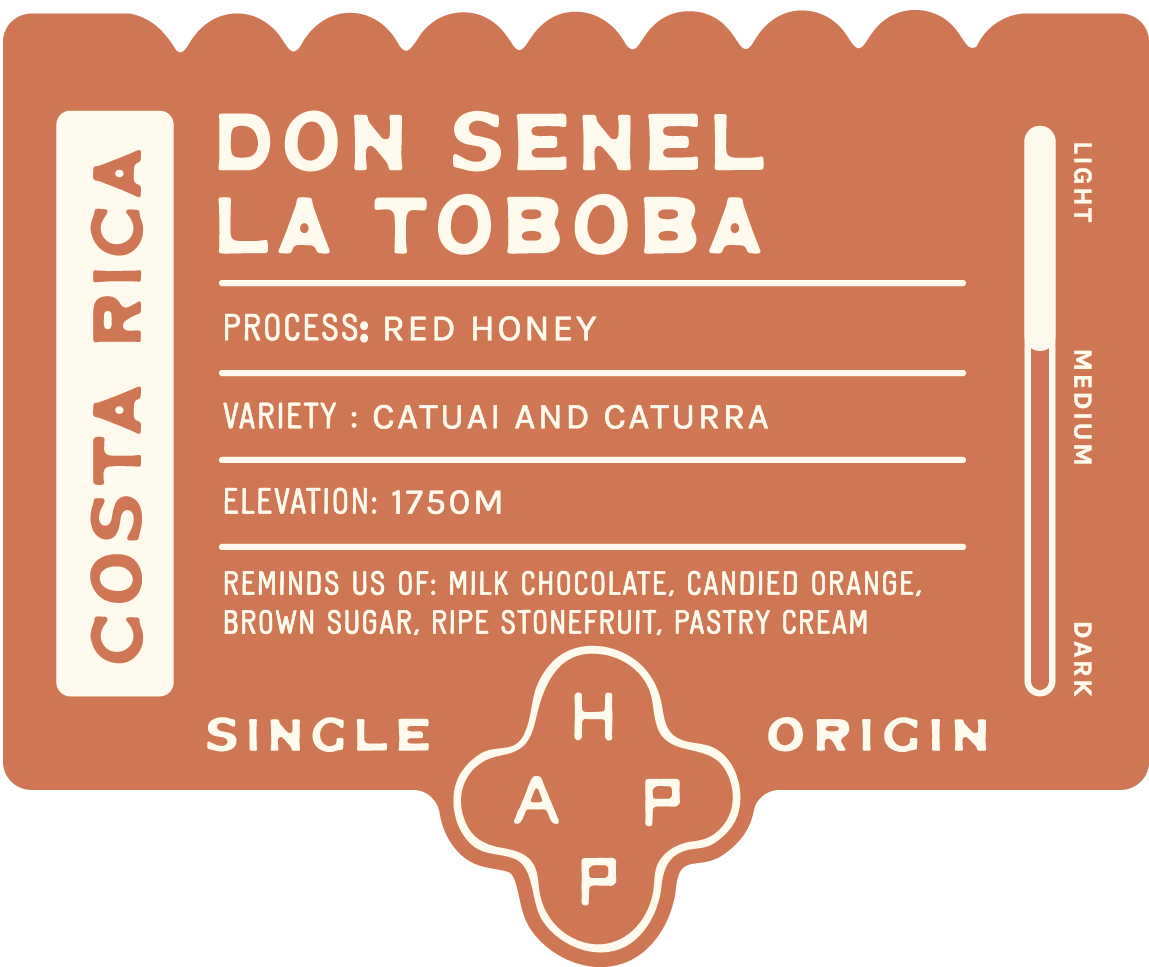
Origin: Costa Rica
Producers: Allan (son) and Senel (father) Campos
Farm/Finca: La Toboba ("The Snake")
Micromill: Don Senel
Elevation: 1750 masl
Variety: Catuai and Caturra
Process: Red Honey
ABOUT THE PRODUCERS
Don Senel Micromill traces its roots to Finca La Toboba, a family farm with a history spanning three generations. Senel Campos inherited the farm from his father, who had inherited it from Senel’s grandmother. In 1968, Senel’s father planted the first coffee trees on the property, establishing a legacy that continues today. Senel now owns and manages the farm alongside his son, Allan, who plays an active role in the daily operations and the ongoing development of both the farm and the mill.
The farm takes its name from the toboba, a type of snake commonly found in the area. During harvest season, Senel and Allan often encounter these snakes in the fields and carefully relocate them to nearby forested areas, reflecting their close relationship with the surrounding environment.
In response to low coffee prices, Senel began processing his own coffee in 2014. His first lot consisted of just 300 kg of coffee from Finca La Toboba, processed using a hand pulper fitted with a washing machine motor and the limited infrastructure available at the time. The quality of those early lots encouraged further investment, and over the following years Senel expanded the operation, improving drying infrastructure, purchasing equipment, and acquiring land suitable for cultivating varieties known for their complex and distinctive cup profiles.
In 2016, Senel and Allan took a major step forward by building their own micromill. In Costa Rica, where farms are often small and land is expensive, many producers deliver their cherries to external mills for processing. Operating their own mill allowed the family to maintain greater control over quality, processing, and traceability while creating new opportunities for growth.
Today, Don Senel includes two farms, Las Huacas and El Cola Roja, planted with varieties such as Obata and Villa Sarchi, alongside newer plantings of SL28, SL14, SL34, Java, Gesha, and others. The rugged topography, nutrient-rich soils, and unique microclimate created by two nearby mountain canyons provide excellent conditions for producing high-quality coffee.
The micromill has evolved significantly since its early days, now featuring raised beds, greenhouse drying infrastructure, and modern processing equipment. Fermentation and drying protocols are managed with increasing precision, including the monitoring of variables such as pH and Brix levels to better understand and influence the final cup profile of each microlot. Through the combined efforts of Senel and Allan, Don Senel continues to build on its family legacy while pursuing innovation and quality in every harvest.
PROCESSING
For this Red Honey lot, cherries are selectively harvested at peak ripeness and evaluated through Brix measurements prior to harvest. This allows the team to assess the sugar content of the fruit and determine the most suitable processing approach for each lot.
Once harvested, the cherries are delivered to the mill and pass through a flotation system, where impurities, underdeveloped cherries, insect-damaged beans, and other defects are removed. The coffee is then placed in a receiving hopper and allowed to rest for approximately 24 hours before pulping.After this resting period, the cherries are depulped and immediately transferred to raised beds. The parchment, still covered with its mucilage, is spread in thin layers and left undisturbed for the first two days of drying. After this initial stage, the coffee is turned every three hours to promote even drying and consistent oxidation.
Throughout the drying process, shade mesh is used above the beds to reduce direct solar exposure while maintaining warm drying conditions. This slower drying environment helps regulate the oxidation of the mucilage, allowing the beans to gradually develop the characteristic reddish to amber coloration associated with the Red Honey process. The coffee remains on the raised beds until reaching the desired moisture content, resulting in a cup profile that reflects both the sweetness retained from the mucilage and the careful drying practices employed at Don Senel Micromill.
GROWING REGION
The Brunca growing region is in the southern area of Costa Rica and comprises the two youngest coffee producing cantons in the country, Coto Brus and Pérez Zeledón. The region is bordered by Panama to the East, the Pacific Ocean to the South and West, and the Cordillera de Talamanca mountains—home to Chirripó, the tallest peak in Costa Rica—to the North.
The Coto Brus canton experiences average temperatures of 18– 26°C and a mean elevation of 955 meters. Coffee cultivation here began in the 1950s when Italian settlers and local Costa Ricans established the first coffee farms in the area. Today, the economy of the canton revolves almost entirely Pérez Zeledón canton, located in the northwest of the Brunca growing region, has developed an economy characterized mostly by agriculture, livestock, trade, industry, and tourism. The primary agriculture in the canton today is sugar cane and coffee, with other fruits and vegetables cultivated as well. Pérez Zeledón’s geographic positioning is prime to connect the Costa Rican capital of San José with the southern areas of the country, especially regions which border Panama such as Coto Brus.